People worth arguing with

Philosopher Compendium

Meet the person behind the position: the question they enter, the move they make and the trouble it causes.

Five ways into the collection

Begin with a question, not a marble bust.

These shelves are deliberate starting points. A thinker may sit on more than one because arguments rarely respect filing systems.

Complete collection · 67 thinkers

A–Z philosopher library

Search a name or idea, then narrow by subject, course or era. Each profile begins with the move worth arguing about.

G. E. M. Anscombe in a shaded warm-grey editorial portrait, holding a small cigar with one narrow muted-gold band while gesturing.
1919–2001 · Twentieth-century philosophyG. E. M. AnscombeAnscombe rebuilds moral philosophy from a careful account of intentional action, refusing to treat intention as a private item hidden behind behaviour.AgencyEthicsMind
Aquinas in a shaded warm-grey editorial portrait, holding a closed Bible with muted-gold page edges and cross.
c. 1225–1274 · Medieval philosophyAquinasAquinas joins Aristotelian explanation with Christian theology, arguing that reason can identify natural ends, moral principles and routes towards a first cause.EthicsKnowledgeAgencyJustice
Hannah Arendt in a shaded warm-grey editorial portrait, speaking with one open hand and wearing a small muted-gold ring brooch.
1906–1975 · Twentieth-century philosophyHannah ArendtArendt treats politics as the fragile space where plural people appear to one another through speech and action, creating a common world no one controls alone.JusticeAgencyEthics
Aristotle examines a sprouting branch with calipers, marked by one restrained gold leaf vein.
384–322 BCE · Ancient Greek philosophyAristotleAristotle asks how living things flourish and treats good judgement as a skill formed through practice, character and attention to particulars.EthicsAgency
Augustine in a shaded warm-grey editorial portrait, opening one hand while wearing a muted-gold stole and cradling a closed book.
354–430 · Late antique philosophyAugustineAugustine explains evil as a corruption of good produced by disordered willing, not as a rival substance created by God.EthicsAgencyMind
Simone de Beauvoir draws a single gold line outward with a fountain pen while raising her free hand in a measured gesture.
1908–1986 · 20th-century philosophySimone de BeauvoirBeauvoir places freedom inside concrete situations, asking how people become subjects while social structures assign roles, limits and meanings in advance.AgencyJusticeEthics
Cesare Beccaria in a shaded warm-grey editorial portrait, carrying a closed folio with one small muted-gold wax seal.
1738–1794 · Enlightenment philosophyCesare BeccariaBeccaria measures punishment by public necessity, demanding clear laws, proportionate penalties and the abolition of torture and unnecessary death.JusticeEthicsAgency
Walter Benjamin in a shaded warm-grey editorial portrait, holding a small muted-gold chess knight naturally in his open palm.
1892–1940 · Twentieth-century philosophyWalter BenjaminBenjamin reads culture as a field of historical pressure, asking how technologies, objects and fragments alter perception and disclose lives that official progress stories leave behind.KnowledgeJusticeAgency
Jeremy Bentham counts a compact abacus in which one muted-gold bead stands apart.
1748–1832 · Modern philosophyJeremy BenthamBentham subjects laws and punishments to a public test: do they reduce suffering and increase wellbeing, or merely preserve inherited authority?EthicsJustice
Berkeley in a shaded warm-grey editorial portrait, gesturing in episcopal dress with one muted-gold ring.
1685–1753 · Early modern philosophyGeorge BerkeleyBerkeley argues that material substance adds nothing intelligible to the ideas we perceive, recasting ordinary objects as mind-dependent without calling them imaginary.KnowledgeMind
Isaiah Berlin in a shaded warm-grey editorial portrait, gesturing precisely with a tiny muted-gold hedgehog brooch.
1909–1997 · Twentieth-century philosophyIsaiah BerlinBerlin argues that genuine human values can conflict without one master principle resolving every loss, making liberty and political restraint permanently important.JusticeAgencyEthics
Camus in a shaded warm-grey editorial portrait, holding a small muted-gold cigarette close to his raised-collar coat.
1913–1960 · Twentieth-century philosophyCamusCamus begins from the clash between our demand for meaning and the world's silence, then asks how to live without denial or surrender.EthicsAgency
David Chalmers stands in a cool faceted grey jacket, carrying one muted-gold top-flip reporter's notebook low beside his hip.
1966– · Contemporary philosophyChalmersChalmers separates explaining what a cognitive system does from explaining why any of it is accompanied by felt experience.MindKnowledge
Confucius in a shaded warm-grey editorial portrait, standing with folded hands above a muted-gold ritual sash clasp.
551–479 BCE · Classical Chinese philosophyConfuciusConfucius treats ethical life as cultivated relationship: humane character becomes visible through ritual, learning and fitting conduct with others.EthicsAgencyJustice
Descartes in a shaded warm-grey editorial portrait, holding a plumb line with a muted-gold plumb bob.
1596–1650 · Early modern philosophyRené DescartesDescartes turns doubt into a method, dismantling inherited confidence in search of foundations that can survive the strongest challenge.KnowledgeMind
Diogenes raises a lantern whose single muted-gold flame searches beyond polite appearances.
c. 404–323 BCE · Ancient Greek philosophyDiogenes of SinopeDiogenes makes philosophy answer to a way of living, using simplicity and provocation to expose artificial needs and respectable pretence.EthicsAgencyJustice
W. E. B. Du Bois in a shaded warm-grey editorial portrait, standing in formal tailoring with round muted-gold spectacle frames.
1868–1963 · Modern and contemporary philosophyW. E. B. Du BoisDu Bois makes racial domination visible as a structure of knowledge and selfhood, dividing how a person sees themselves from how a hostile society makes them appear.JusticeKnowledgeMindAgency
Elisabeth of Bohemia stands in a dark faceted period dress, holding a letter closed with one restrained muted-gold seal.
1618–1680 · Early modern philosophyElisabeth of BohemiaElisabeth forces Cartesian dualism to explain contact: how can an unextended thinking substance move an extended body?MindAgencyEthics
Epicurus in a shaded warm-grey editorial portrait, standing calmly with one small muted-gold fig held beside his hip.
341–270 BCE · Hellenistic philosophyEpicurusEpicurus makes pleasure the good but strips it of extravagance, locating happiness in freedom from bodily pain, mental disturbance and needless fear.EthicsAgencyKnowledge
Frantz Fanon in a shaded warm-grey editorial portrait, standing directly while carrying a compact radio with a muted-gold grille.
1925–1961 · Twentieth-century philosophyFrantz FanonFanon analyses colonialism as a system that occupies land, language, embodiment and self-understanding, making liberation both political and psychological.JusticeMindAgency
Foot in a shaded warm-grey editorial portrait, cradling a small muted-gold toy steam train.
1920–2010 · Contemporary philosophyFootFoot reconnects moral judgement with the evaluation of living things, while using sharply structured cases to test intention, duty and harm.EthicsAgency
Michel Foucault in a shaded warm-grey editorial portrait, speaking with one open hand as a subtle muted-gold light plane catches his bald crown.
1926–1984 · Twentieth-century philosophyMichel FoucaultFoucault traces how institutions and expert practices produce the categories through which people are observed, normalised and invited to understand themselves.JusticeKnowledgeAgencyMind
Frankfurt in a shaded warm-grey editorial portrait, holding a compact muted-gold key across his open palm.
1929–2023 · Contemporary philosophyFrankfurtFrankfurt asks whether freedom lies less in alternative possibilities than in which desires an agent identifies with and makes effective.AgencyEthicsMind
Fricker in a shaded warm-grey editorial portrait, listening with one gently open hand and a small muted-gold hoop earring.
1966– · Contemporary philosophyFrickerFricker shows that injustice can damage a person specifically as a knower, shaping who receives credibility and which experiences can be understood.KnowledgeJusticeEthics
Goldman in a shaded warm-grey editorial portrait, checking a wristwatch with a muted-gold case.
1938–2024 · Contemporary philosophyGoldmanGoldman shifts epistemic attention from what a believer can inspect internally to whether the process producing a belief reliably connects it with truth.KnowledgeAgency
Hegel in a shaded warm-grey editorial portrait, opening one hand beneath a tiny muted-gold owl cravat pin.
1770–1831 · German idealismHegelHegel treats freedom and reason as achievements that emerge through conflict, recognition and historically developing forms of social life.AgencyMindJusticeKnowledge
Heidegger in a shaded warm-grey editorial portrait, carrying a carpenter's hammer with a muted-gold head low by his side.
1889–1976 · Twentieth-century philosophyHeideggerHeidegger redirects philosophy from cataloguing beings to the question of what it means for anything to be intelligible at all.MindAgencyKnowledge
John Hick in a shaded warm-grey editorial portrait, speaking with one open hand and wearing a folded muted-gold pocket square.
1922–2012 · Contemporary philosophyJohn HickHick reframes a world containing difficulty as an environment for freely developed persons, then extends his philosophy towards plural responses to an ineffable Real.EthicsKnowledgeAgency
Hobbes in a shaded warm-grey editorial portrait, gripping a compact muted-gold sceptre beneath a layered cloak.
1588–1679 · Early modern philosophyHobbesHobbes grounds political authority in the need to escape insecurity, asking what power must exist before promises and cooperation can reliably hold.JusticeAgencyMind
bell hooks in a shaded warm-grey editorial portrait, speaking with an open hand while wearing one long muted-gold necklace.
1952–2021 · Contemporary philosophybell hookshooks places race, class and gender inside one analysis of domination, while treating education and love as demanding practices capable of transforming it.JusticeEthicsAgencyKnowledge
Hume in a shaded warm-grey editorial portrait, holding a two-pronged muted-gold tuning fork.
1711–1776 · Early modern philosophyDavid HumeHume asks human reason to account for its habits, showing how causation, self and morality depend on practices that argument alone cannot manufacture.KnowledgeEthicsAgency
Irenaeus in a shaded warm-grey editorial portrait, carrying a dark sculptor's chisel with one narrow muted-gold collar.
c. 130–c. 202 · Early Christian thoughtIrenaeusIrenaeus presents creation as good but unfinished, with human beings capable of growing from immaturity towards likeness to God.EthicsAgency
Kant in a shaded warm-grey editorial portrait, turning in a three-quarter pose with a muted-gold wig bow.
1724–1804 · Modern philosophyImmanuel KantKant asks what rational agents must demand of themselves, treating persons as law-makers who may never be reduced to convenient instruments.EthicsKnowledgeJustice
Soren Kierkegaard in a shaded warm-grey editorial portrait, walking with a cane whose curved handle is muted gold.
1813–1855 · Nineteenth-century philosophySoren KierkegaardKierkegaard resists living by abstraction, asking how a particular person becomes responsible for commitments no system can make on their behalf.AgencyEthicsMind
Locke in a shaded warm-grey editorial portrait, making the first mark on a blank slate with a small gold piece of chalk.
1632–1704 · Early modern philosophyJohn LockeLocke connects knowledge to experience, political authority to consent and personal identity to continuity of consciousness.KnowledgeMindJustice
Mackie in a shaded warm-grey editorial portrait, turning one palm upward beneath a compact muted-gold bow tie.
1917–1981 · Twentieth-century philosophyMackieMackie argues that ordinary moral claims purport to report objective requirements, but that no such requirements exist.EthicsKnowledge
Karl Marx in a shaded warm-grey editorial portrait, holding a closed charcoal political pamphlet marked with a gold five-pointed star.
1818–1883 · Nineteenth-century social and political philosophyKarl MarxMarx explains capitalism as a historically specific social order whose ordinary exchanges conceal relations of labour, power and exploitation that people can collectively transform.JusticeAgencyKnowledgeEthics
Mary Midgley in a shaded warm-grey editorial portrait, cradling a small muted-gold wire atlas in both hands.
1919–2018 · Contemporary philosophyMary MidgleyMidgley dismantles one-story pictures of human nature, arguing that people are social animals whose motives cannot be reduced to selfish genes, pure reason or isolated choice.EthicsMindAgencyKnowledge
John Stuart Mill opens a book as one muted-gold line escapes its uniform margin.
1806–1873 · Modern philosophyJohn Stuart MillMill defends individuality, open argument and a richer utilitarianism in which the quality of human flourishing matters alongside quantity.EthicsJusticeAgency
Iris Murdoch in a shaded warm-grey editorial portrait, holding a closed book marked by a simple muted-gold bell.
1919–1999 · Twentieth-century philosophyIris MurdochMurdoch relocates moral work inside attention: becoming better involves learning to see other people and reality without the ego's consoling distortions.EthicsMindAgency
Nagel in a shaded warm-grey editorial portrait, looking upward with a small muted-gold bat brooch.
1937– · Contemporary philosophyNagelNagel makes the first-person point of view philosophically unavoidable, asking what an objective account leaves out when there is something it is like to be a subject.MindKnowledgeEthics
Friedrich Nietzsche tests a cracked tablet with a hammer and one muted-gold fracture line.
1844–1900 · Modern philosophyFriedrich NietzscheNietzsche asks what forms of life created our values and whether inherited moral certainty conceals fear, resentment or exhaustion.EthicsAgency
Robert Nozick transfers one token between open hands along a single muted-gold path.
1938–2002 · Contemporary philosophyRobert NozickNozick argues that justice concerns how holdings were acquired and transferred, not whether the final distribution matches a preferred social pattern.JusticeAgency
Martha Nussbaum opens her hands across one muted-gold threshold, without an enclosing frame.
1947– · Contemporary philosophyMartha NussbaumNussbaum asks what people are actually able to do and be, shifting justice from equal resources on paper to the real conditions of a dignified life.JusticeEthics
William Paley in a shaded warm-grey editorial portrait, steadying a muted-gold pocket watch beneath a dark tricorne with muted-gold edging.
1743–1805 · Modern philosophyWilliam PaleyPaley argues that intricate functional organisation in living things points beyond unguided accident towards intelligent design.KnowledgeEthics
Parfit in a shaded warm-grey editorial portrait, carrying a muted-gold rangefinder camera low at his hip.
1942–2017 · Contemporary philosophyParfitParfit argues that personal identity may matter less than the psychological relations that connect lives across time.MindEthicsAgencyJustice
Alvin Plantinga in a shaded warm-grey editorial portrait, smiling and gesturing while wearing thin muted-gold spectacle frames.
1932– · Contemporary philosophyAlvin PlantingaPlantinga argues that rational belief need not always rest on argument and that the logical problem of evil fails if free creatures might go wrong in every feasible world.KnowledgeEthicsAgency
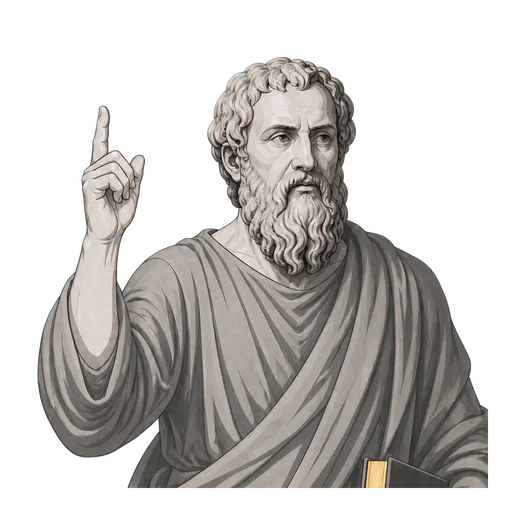
Plato in a shaded warm-grey editorial portrait, pointing upward and holding a closed book with a muted-gold spine.
c. 427–347 BCE · Ancient Greek philosophyPlatoPlato turns philosophy into a sustained argument about knowledge, justice, reality and the education of desire.KnowledgeEthicsJustice
Putnam in a shaded warm-grey editorial portrait, carrying a muted-gold tumbler filled with visibly neutral water.
1926–2016 · Contemporary philosophyPutnamPutnam repeatedly tests whether mind, meaning and truth can be confined inside an individual, using machines, Twin Earth and sceptical scenarios to force the question.MindKnowledge
John Rawls arranges covered tokens behind a neutral screen with one muted-gold edge.
1921–2002 · Contemporary philosophyJohn RawlsRawls asks which principles people would choose for society if nobody could tailor the rules to their own social advantage.JusticeEthics
Jean-Jacques Rousseau in a shaded warm-grey editorial portrait, supporting a compact muted-gold botanical sprig on his open palm.
1712–1778 · Enlightenment philosophyJean-Jacques RousseauRousseau asks how social dependence transforms natural self-concern into rivalry, then seeks a political order in which obedience can remain compatible with freedom.JusticeAgencyEthics
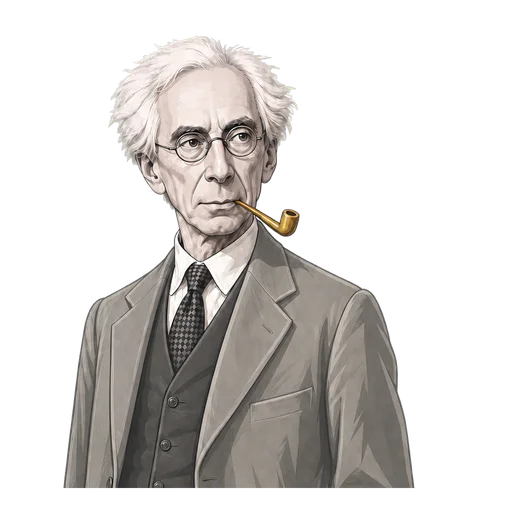
Russell in a shaded warm-grey editorial portrait, standing naturally with a bent muted-gold pipe.
1872–1970 · Modern analytic philosophyBertrand RussellRussell treats clarity as philosophical work: separate the claims, expose their logical relations and discover whether the original problem survives.KnowledgeAgency
Ryle in a shaded warm-grey editorial portrait, holding a long muted-gold drafting compass securely beside his hip.
1900–1976 · Twentieth-century philosophyRyleRyle argues that the mind is not a ghostly object hidden inside the body, but is revealed in the organisation of intelligent conduct and capacities.MindKnowledgeAgency
Sartre in a shaded warm-grey editorial portrait, holding a small muted-gold cup of coffee.
1905–1980 · Twentieth-century philosophySartreSartre treats human beings as unfinished projects: we become what we are through choices made in situations we did not choose.AgencyMindEthics
Searle in a shaded warm-grey editorial portrait, holding a muted-gold card marked with the dark Chinese character for heart-mind.
1932– · Contemporary philosophySearleSearle insists that manipulating symbols by rules is not yet understanding them, and that minds are biological phenomena with genuine intentional content.MindAgencyKnowledge
Peter Singer places equal tokens near and far along one continuous muted-gold line.
1946– · Contemporary philosophyPeter SingerSinger presses impartial concern into everyday life, asking whether distance, species and ordinary spending habits are morally relevant differences.EthicsJustice
Smart in a shaded warm-grey editorial portrait, standing informally with a small muted-gold lightning-bolt pin.
1920–2012 · Twentieth-century philosophySmartSmart proposes that sensations are brain processes described in another vocabulary, removing the need for a second mental substance or dangling properties.MindEthicsKnowledge
Socrates in a shaded warm-grey editorial portrait, gesturing through an argument while holding a shallow muted-gold hemlock cup.
c. 470–399 BCE · Ancient Greek philosophySocratesSocrates makes examination a way of life, testing confident claims until speakers can see what they know, what they assume and how they should live.EthicsKnowledgeAgency
Robert C. Solomon in a shaded warm-grey editorial portrait, teaching with two lively gestures and one muted-gold cufflink.
1942–2007 · Contemporary philosophyRobert C. SolomonSolomon treats emotions as intelligent, evaluative ways of engaging with the world rather than forces that simply happen to a passive self.MindEthicsAgency
Ernest Sosa in a shaded warm-grey editorial portrait, holding an arrow low with its fletching rendered muted gold.
1940– · Contemporary philosophyErnest SosaSosa models knowledge as successful intellectual performance: a belief counts well when it is true because it was competently formed.KnowledgeAgency
Spinoza in a shaded warm-grey editorial portrait, holding a clear optical lens by its thin muted-gold rim.
1632–1677 · Early modern philosophySpinozaSpinoza places mind and body within one necessary natural order, redefining freedom as active understanding rather than escape from causation.AgencyMindEthicsKnowledge
Richard Swinburne in a shaded warm-grey editorial portrait, explaining with one open hand while wearing a narrow muted-gold tie.
1934– · Contemporary philosophyRichard SwinburneSwinburne builds a cumulative probabilistic case for God, arguing that one simple personal explanation can make a wide range of features of the world more likely.KnowledgeMindEthics
Turing in a shaded warm-grey editorial portrait, wearing a punched muted-gold data card in his breast pocket.
1912–1954 · Twentieth-century philosophy and computingTuringTuring replaces the foggy demand to define machine thinking with operational tests of what machines can compute and how convincingly they can converse.MindKnowledgeAgency
Wittgenstein in a shaded warm-grey editorial portrait, gripping a long muted-gold fireplace poker.
1889–1951 · Twentieth-century philosophyWittgensteinWittgenstein asks how language gets its grip, repeatedly turning philosophical puzzles back towards the practices in which words have a use.KnowledgeMind
Wolf in a shaded warm-grey editorial portrait, holding a small muted-gold tuning fork.
1952– · Contemporary philosophyWolfWolf locates meaning where subjective attraction meets objective worth: a life must be engaged, but not every engaging project is worth loving.EthicsAgency
Mary Wollstonecraft in a shaded warm-grey editorial portrait, holding a small muted-gold polling card while gesturing outward.
1759–1797 · Enlightenment philosophyMary WollstonecraftWollstonecraft turns Enlightenment claims about reason and freedom against a society that educates women for dependence and then mistakes the result for nature.JusticeAgencyEthics
Zhuangzi watches a butterfly rest above his open hand, with one muted-gold wing detail.
4th century BCE · Classical Chinese philosophyZhuangziThe Zhuangzi uses story, humour and transformation to loosen distinctions that have become too rigid for skilful life.KnowledgeMindAgency
All resources

A name is useful when it leads back to an argument.

Philosophy Lab