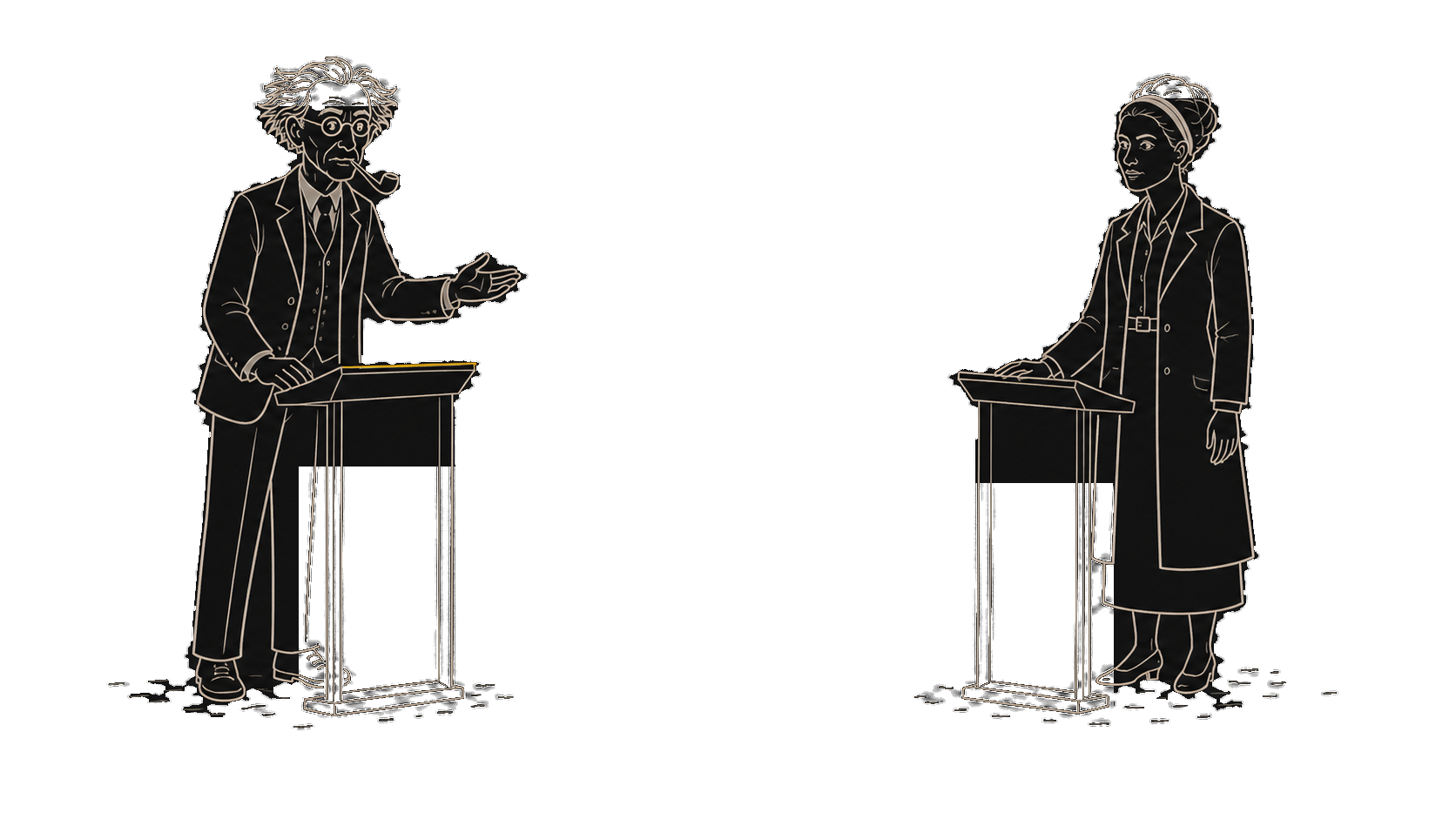
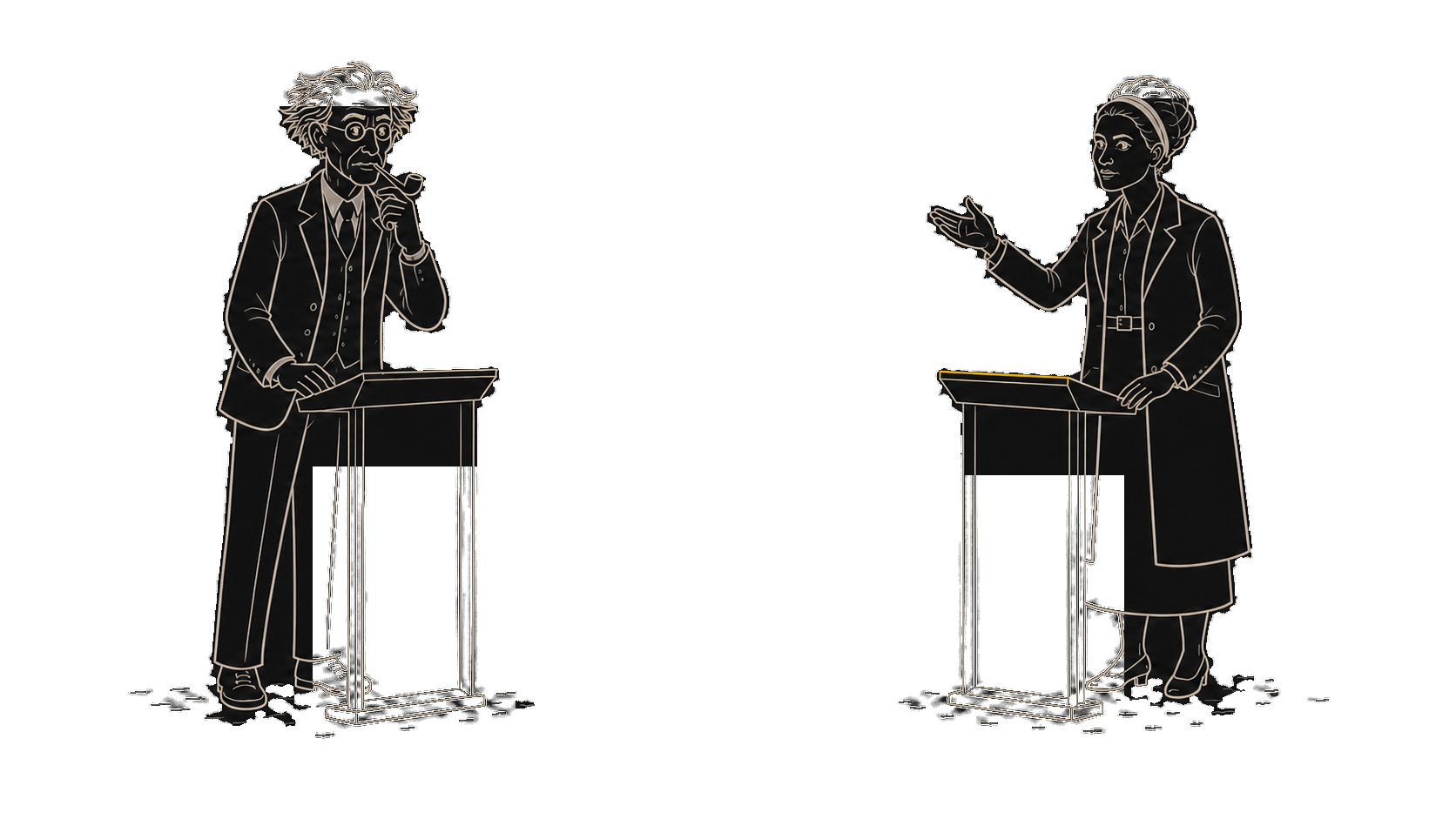
Bout 1 / Russell v the loudest summary
So Russell wants every lesson to become endless arguing with no knowledge and no answers.
Russell proposes that pupils debate one moral question before examining objections.
- Appeal to tradition
- Appeal to authority
- Straw man
Straw man: The reply replaces a limited proposal with an extreme, easier target. Refuting the caricature leaves Russell's actual proposal untouched.
Fallacy: straw manBout 2 / Beauvoir v the attendance register
Ignore her objection. She arrived late twice last term.
Beauvoir objects that a surveillance policy gives unchecked power to administrators.
- Ad hominem
- Post hoc
- Equivocation
Ad hominem: The reply attacks the speaker's conduct instead of answering the claim about unchecked power. A flawed person can still make a sound argument.
Fallacy: abusive ad hominemBout 3 / Diogenes v two suspiciously tidy boxes
Either ban every phone all day or accept total intellectual collapse.
A school is deciding how to govern phone use in different lessons.
- Composition
- False dilemma
- Tu quoque
False dilemma: The argument presents two exhaustive options while ignoring restricted use, teacher discretion, storage rules and other alternatives.
Fallacy: false dilemmaBout 4 / Descartes v a premise wearing its conclusion
The rule is just because it follows justice; we know it follows justice because it is just.
A minister is asked to justify a new rule as fair.
- Slippery slope
- Circular reasoning
- Hasty generalisation
Circular reasoning: The conclusion is simply returned as its own support. Restating justice in the premise provides no independent reason to accept the rule.
Fallacy: begging the questionBout 5 / Kant v administrative prophecy
Allow this extension and soon nobody will submit anything; qualifications will collapse.
One pupil requests a documented extension after emergency surgery.
- Loaded question
- Appeal to authority
- Slippery slope
Slippery slope: The argument asserts a chain from one controlled exception to total collapse without establishing the steps or showing why safeguards cannot interrupt them.
Fallacy: slippery slopeBout 6 / Zhuangzi v a word changing masks
The laws of nature cannot be broken. Parliament makes laws. Therefore Parliament's laws cannot be broken.
The same word quietly changes meaning between the premises and conclusion.
- Equivocation
- Composition
- Post hoc
Equivocation: A law of nature describes regularity; a law of Parliament prescribes conduct. Treating the two senses as identical manufactures the conclusion.
Fallacy: equivocationBout 7 / the famous name enters first
A great philosopher said it, so animals cannot experience pain.
A celebrated historical philosopher calls non-human animals unfeeling machines.
- Genetic fallacy
- Appeal to pity
- Appeal to authority
Appeal to authority: Expertise can supply evidence, but a famous name cannot settle a contested empirical and philosophical claim—especially when the evidence has changed.
Fallacy: inappropriate appeal to authorityBout 8 / Nietzsche v two convenient examples
Those two activists were hypocrites, so political activism is hypocrisy.
Two prominent campaigners are exposed as hypocrites.
- Straw man
- Hasty generalisation
- Circular reasoning
Hasty generalisation: Two selected cases cannot support a conclusion about an enormous and varied class. The sample is too small and likely chosen for its drama.
Fallacy: hasty generalisationBout 9 / Russell v the assembled object
Every brick is light enough to lift, therefore the whole building is light enough to lift.
Every brick in a building can be lifted by one person.
- Fallacy of composition
- Fallacy of division
- Equivocation
Fallacy of composition: A property of each part need not belong to the whole assembled from them. Total mass is precisely what changes at the collective level.
Fallacy: compositionBout 10 / Kant v the archive of old failures
You lied last year, so your claim that lying is wrong must be false.
A speaker argues that lying to escape responsibility is wrong.
- Ad hominem circumstance
- Tu quoque
- False dilemma
Tu quoque: The speaker's hypocrisy may matter when judging character, but it does not refute the moral claim. Failure to live by a rule is not evidence that the rule is false.
Fallacy: tu quoqueBout 11 / the timetable claims causation
The results rose after philosophy arrived, therefore philosophy caused the rise.
A school introduces philosophy. Exam results rise the following year.
- Post hoc
- Hasty generalisation
- Slippery slope
Post hoc: Sequence alone does not establish causation. Staffing, cohort differences, assessment changes and prior trends remain live alternative explanations.
Fallacy: post hoc ergo propter hocBout 12 / the question smuggles its verdict
When did you stop pretending that free will is real?
A sceptic has not conceded that belief in free will is pretence.
- Circular reasoning
- Genetic fallacy
- Loaded question
Loaded question: Any direct answer concedes the unproved accusation that the person was pretending. The hidden premise must be rejected before the question can be answered.
Fallacy: loaded question